
Using Assessments to identify Organizational Culture
- joannewestonedes
- May 18, 2020
- 5 min read

Updated: May 19, 2020
Overview
This post describes how the use of the Organizational Development evaluation tools OCTAPACE and the Five Dysfunctions of a Team Assessment can be used to help identify issues related to culture and teamwork.

A US-based financial services company opened a back-office operation in Manila, Philippines. The 25+ staff was made up of 4 teams all with local team leads. Members of the senior management made frequent visits to Manila, however, none was based full time in the Philippines. The team leads placed much focus on building trust within their teams and built strong relationships with their analysts and with each other. However, after several months, the US-based senior leadership team was not seeing the desired results. Confidence in the Manila operation's ability to meet expectations was waning and they started to doubt the significant investment made in setting up the Manila office. Joanne, an organizational development consultant and coach, was asked to conduct an assessment of the teams and to make recommendations.
During interviews with team leads, team members, and senior managers in the US, one US manager complained that he expected the Manila team leads to be aware of potential problems and communicate them to the relevant counterparts in the US or, better still, solve the problem themselves. Instead, they appeared to preferred to "bury their heads in the sand", a practice that negatively impacted customer service SLAs not to mention eroding trust and confidence. Manila's team members reported feeling shy about highlighting problems to their US co-workers whom they described as abrupt and intimidating. Joanne understood that the culture in the Manila office was at odds with the leadership and work style of US colleagues. Her hypothesis was that a clash between Collectivist and Individualist cultures of the US and Philippines operations were at play.
Joanne decided to administer assessments to identify for her client where the challenges lay and how best to address them.
OCTAPACE
The OCTAPACE profile is a 40-item instrument that gives the profile of an organization’s ethos in eight values:
Openness
Confrontation
Trust
Authenticity
Pro-action
Autonomy
Collaboration, and
Experimentation.
Process
Team members were sent a link to the 40 item assessment via Google form.


The assessment results for three individuals (one analyst, one team lead and one US-based Manager) are displayed chart below. The charts show how strongly employees believe that each value is currently valued. Joanne decided to ask the US-based senior manager to complete the assessment with an ideal future culture in mind; a culture that he hoped would be better able to support the US business.
The chart below shows the OCTAPACE results of an analyst with no supervisory responsibilities:
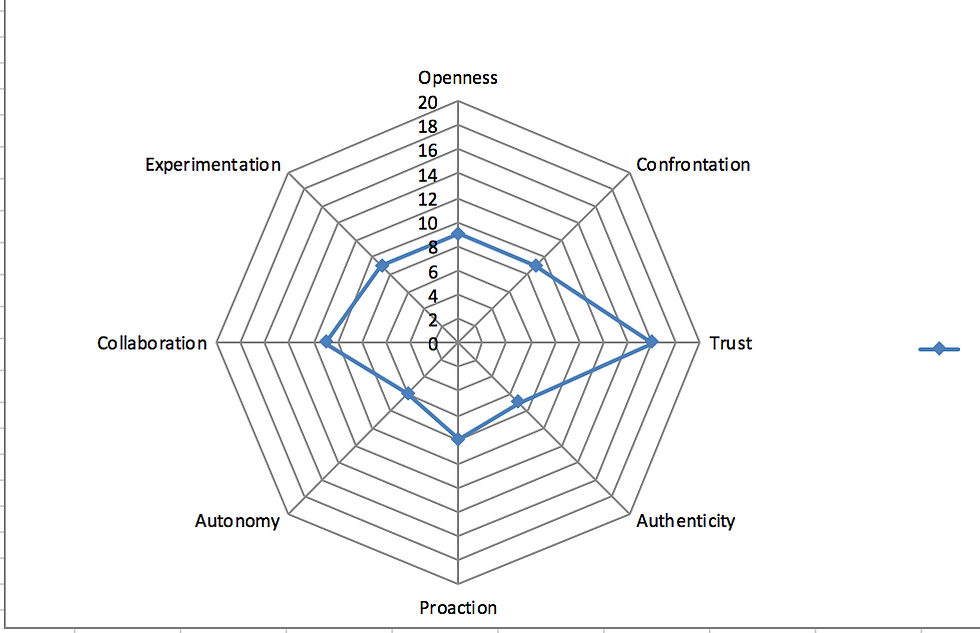
The chart below shows the OCTAPACE results of a Team Lead responsible for a team of 5 analysts and reporting to a US-based Manager:

The chart below shows the OCTAPACE results of a US-based Manager envisioning the culture needed for the Manila-based operation to be successful:

The OCTAPACE results proved effective in identifying potential gaps between the culture US-based team expected and the actual working atmosphere of the Manila-based team. Whereas the US manager sought an organizational culture of innovation, openness, and independence, the Filipino analyst and Team Lead seemed to be relying on a strong team culture of Trust. The chart below shows the three results overlayed to give a clear picture of where the biggest gaps in the organization lie.

Five Dysfunctions of a Team
With an organization based on two continents and separated by a 12-hour time difference, teamwork was critical for the business to thrive. Noting that Trust was a critical foundation piece of The Five Dysfunctions of a Team. Joanne decided to administer a second assessment, which would help the teams to see the relevance of team dysfunctions in their particular situation.
The Five Dysfunctions are illustrated in the pyramid below.

Source: Five Dysfunctions of a Team, Patrick Lencioni
Process
Team members were sent a link to the 40 item assessment via Google Form.


The consolidated results for all analysts and team leads are represented in the chart below.

Joanne referred to the scoring below to analyze the results and make her recommendations:

Source: Five Dysfunctions of a Team, Patrick Lencioni
The two main challenges for the team leads were in the areas of Accountability and Conflict. While for the analysts, Results, Accountability, Commitment, and Conflict were all areas of concern. This translated to team leads having difficulties asserting themselves with US counterparts, as well as managing their analysts to perform independently and to required standards.
It is useful at this point to make some general comments about Filipino culture. In the Philippines, which has a more collectivist culture. it is not appropriate to cause discomfort to others especially if there is an actual or perceived difference in status. Culture In the Philippines is in transition due to a growing middle class, a more connected digital world, as well as a booming contact center and shared services industry. However, traditionally Filipino culture has recognized, expected, and rewarded values such as harmony, modesty, face-saving, respect of and looking to hierarchy for direction. While these values have been successful in traditional Filipino-run organizations, they pose challenges when two very different sets of cultures attempt to work together towards a common goal. Due to the remote location and time difference between teams, US counterparts are not aware of operational issues as they arise. They, therefore, rely heavily on independent problem-solving and timely communication of issues.
Recommendations
These results along with a strong awareness of the cultural environment influencing all the participants, helped Joanne to make recommendations for an OD coaching program that would effectively address the issues. She would design a series of coaching and learning interventions for employees both in Manila and the US.
For the team leads and US employees, she proposed a series of interactive virtual workshops around cultural competence. This would build awareness of the values at play behind certain behaviors. After an initial Phase 1 of cultural awareness, she would facilitate culture creation workshops where a new culture, mindful of where everyone's personal culture, would be designed.
For the Manila team leads. Joanne planned to administer the MBTI Step II assessment along with a Cultural Values activity. These would allow her to demonstrate the difference between core and acquired values. Group and individual coaching would enable her to focus on individual development goals and challenges identified in the Five Dysfunctions results. Given the very strong cultural values that she anticipated might hinder actual change, she prepared to use the Immunity to Change Model. This model is a structured process that allows participants to identify, then plan how to test and challenge assumptions and limiting beliefs in the real world.
Team leads who previously focused on building strong relationships (and friendships) with team members, would also be given management skills training including coaching for performance and results.
Summary
The OCTOPACE tool helped identify the current and desired future culture of the organization while the Five Dysfunctions of a Team tool identified specific behaviors to focus on when developing the team leads to better communicate with their US counterparts, as well improving their management skills with their teams.
Comments